On-Site Warehouse
Storage and staging space co-located with our fleet, cross-dock, and lumper crews.

Warehousing Services
Our Rochester, NY warehouse gives shippers a flexible home base for the moves in between the moves — temporary storage, inventory staging, overflow support, and LTL handling under one roof.
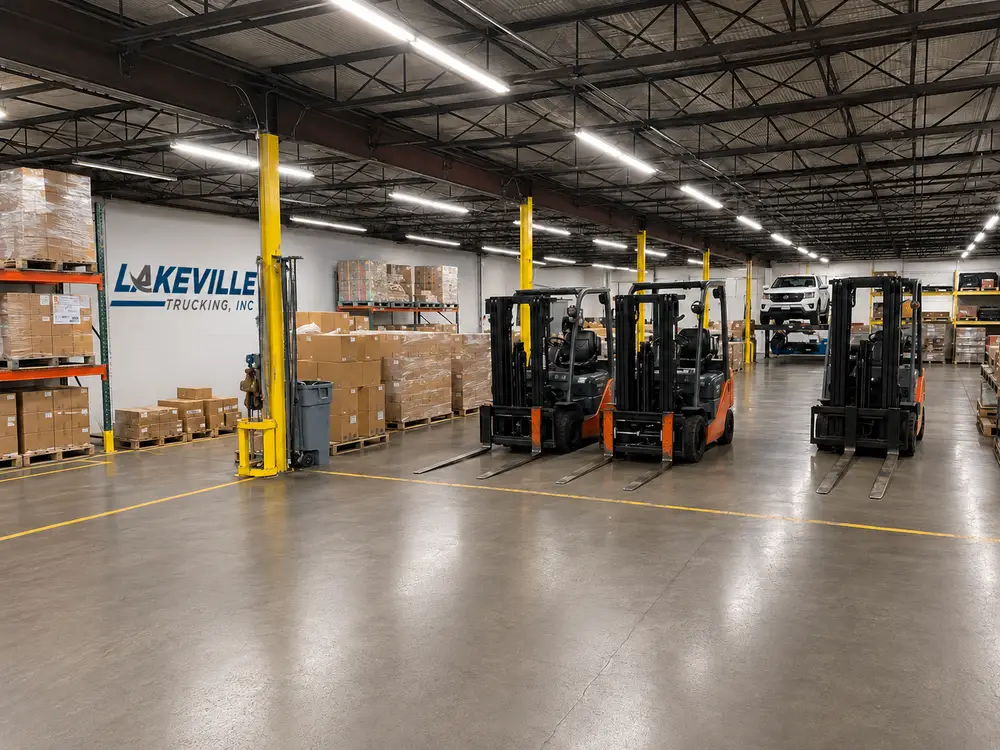
Warehousing at Lakeville isn't a 3PL contract — it's a freight-supporting capability. Our on-site Rochester warehouse exists to solve the problems shippers actually run into when their freight is moving: a load that needs to hold for a scheduled appointment, an inventory position that outgrew the shipper's own space, an LTL consolidation that has to happen before regional distribution can proceed.
Because the warehouse is co-located with our fleet and cross-dock, freight can enter and exit the building in whichever mode makes sense for the move. That flexibility is exactly what makes Lakeville warehousing valuable — it isn't a storage silo, it's a working extension of our transportation program.
For shippers who need short-term warehousing, overflow capacity, or a staging platform for regional distribution, Rochester is a strategic footprint. Positioned in Western New York, we serve as a natural hand-off point between Northeast supply chains and long-haul lanes reaching California, Texas, Florida, and the Pacific Northwest.
Storage and staging space co-located with our fleet, cross-dock, and lumper crews.
Warehouse space sized for the length of the move, not a multi-year contract.
Hold product ahead of scheduled deliveries so trailers move on the receiver's clock, not ours.
Efficient receipt, consolidation, and re-dispatch of less-than-truckload freight.
Absorb inventory when the shipper's own warehouse runs out of pallet positions.
Strategically located in Western New York — a natural Northeast hand-off.
Most warehousing needs aren't permanent. A shipper builds inventory ahead of a promotion, absorbs a season, or holds product for a scheduled delivery window. Traditional 3PL contracts don't fit those shapes — they're built for multi-year commitments and steady-state pallet counts.
Lakeville warehouses freight the way most shippers actually need it: short-term, flexible, and priced to the actual work. Product can arrive by our trucks or someone else's, hold for the required window, and dispatch out again when the receiver is ready. That flexibility is the whole point.
Staging is warehousing with a purpose. A regional distribution program works best when product is positioned close to the receivers, ready to load, and paired with a carrier that can move it on the appointment. That's exactly what our Rochester warehouse enables.
Shippers use our warehouse to hold DC-bound freight until the receiver's window opens, to consolidate mixed inventory into full truckload volumes, and to smooth out inbound waves that don't align with outbound schedules. Because our trucks are next door, the transition from staging to delivery is one continuous operation.
Less-than-truckload freight is where warehousing and transportation overlap most. Individual LTL shipments arrive, get sorted, and either move out on partial trailers or consolidate with other freight bound for the same region. Lakeville handles that entire workflow at our Rochester facility.
Because we run a large regional fleet, LTL freight that lands in our warehouse frequently rides out on a Lakeville trailer within the same day or the next. That combination — warehouse and carrier under one roof — is what makes LTL consolidation efficient instead of expensive.
Every shipper's warehouse fills up eventually. A big receipt lands, a shipment ships late, or a season shifts pallet count above capacity. When that happens, product still has to go somewhere — and it has to go somewhere that can also ship it back out cleanly.
Lakeville's overflow warehousing program is built for exactly that situation. Extra pallet positions when the shipper's own facility is full, with a trucking operation next door ready to redistribute the inventory back to the shipper or forward to receivers as needed.
While our warehousing footprint is primarily ambient, the co-location with our reefer fleet means refrigerated freight can be handled with minimal exposure. Trailers can be dropped, loaded, or transferred with reefers active, protecting temperature-controlled product across warehouse-side operations.
For shippers whose freight profile mixes ambient and temperature-controlled product, that flexibility is a real operational advantage — the warehouse becomes a single hand-off point for the entire supply chain.
Warehousing works best in combination with our other capabilities. These pages go deeper on the services shippers most often pair with it.
Dock-to-dock transfers when freight needs to move through the building without long-term storage.
Learn moreCold chain logistics for food shippers who need warehousing paired with reefer distribution.
Learn moreThe dry van fleet that moves freight in and out of our warehouse every day.
Learn moreSee every capability Lakeville offers under one roof — refrigerated, dry van, warehousing, cross docking, and dedicated freight.
Back to hubOur program is built for short-term and flexible warehousing — temporary storage, inventory staging, and overflow support rather than multi-year 3PL contracts.
Our warehouse footprint is primarily ambient, but co-location with our reefer fleet allows refrigerated freight to be handled with active reefers on trailers when needed.
Yes. LTL receipt, consolidation, and re-dispatch are core parts of our warehousing operation, and consolidated freight frequently ships out on a Lakeville trailer within the same or next day.
100 Mushroom Blvd, Rochester, NY 14623 — co-located with our fleet operations, cross-dock, and lumper crews.
Yes. Inbound freight can arrive by any carrier. Our team handles receipt, put-away, and any subsequent outbound movement.
Pricing is scoped to the actual work — pallet positions, dwell time, and any handling required. Contact our team with your freight profile for a quote.
Tell our logistics team about your lanes, volumes, and service expectations. We'll build a solution that keeps your product moving on schedule.