Same-Day Freight Transfer
Product moves from inbound to outbound trailer with minimal dwell — often within hours.

Cross Docking
Rapid dock-to-dock freight transfer, LTL consolidation, and regional distribution support at our Rochester, NY facility. Product moves through the building — it doesn't sit in it.
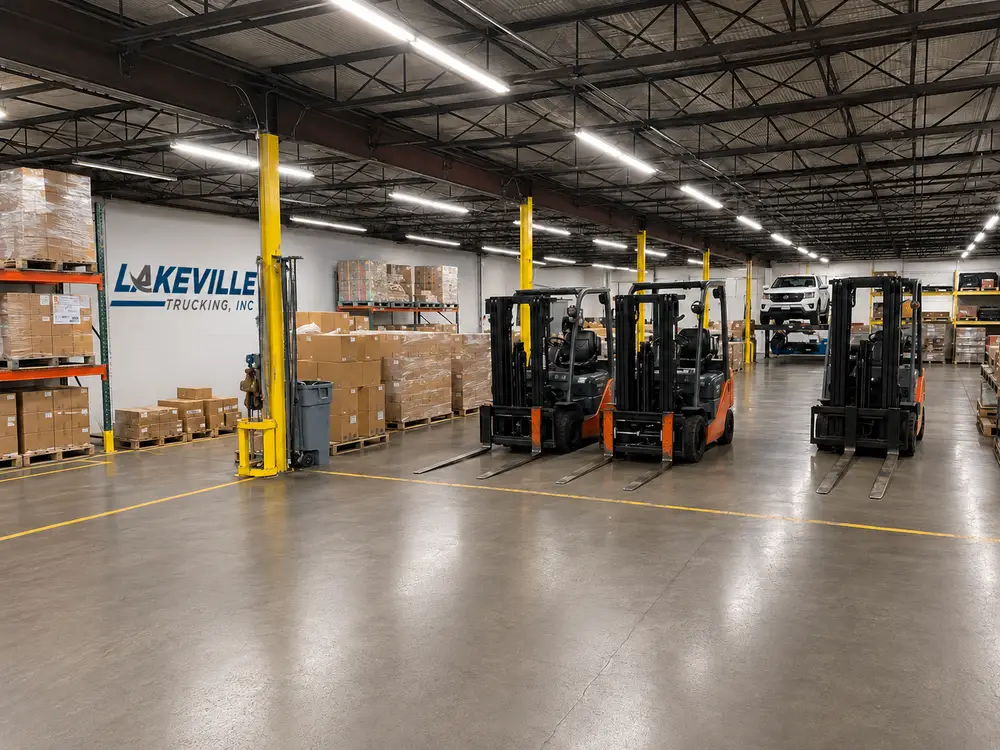
Cross docking is warehousing's opposite. Instead of holding product on the rack, cross-dock operations receive freight on one dock, sort it, and dispatch it out another dock — often on the same day. When that workflow is done well, shippers get the distribution benefit of a warehouse without paying storage costs, and product reaches the receiver faster.
Lakeville's Rochester cross-dock is built for that pace. Because our fleet is co-located, freight that hits our dock can be sorted, matched to outbound trailers, and dispatched to Northeast receivers with minimal dwell. For food shippers, that means less time out of the cold chain. For retail and manufacturing shippers, it means shorter total transit and lower inventory carrying costs.
Cross docking also unlocks efficient LTL consolidation. Multiple smaller shipments bound for the same region can combine into a single outbound trailer, saving cost per pallet while keeping delivery windows intact. That's regional distribution done right — and it's exactly what our facility is set up to do.
Product moves from inbound to outbound trailer with minimal dwell — often within hours.
Combine smaller shipments bound for the same region into a single outbound truckload.
Skip the storage step — receive, sort, and re-dispatch in one continuous operation.
Freight doesn't sit long enough to accrue storage fees or tie up working capital.
Reefer trailers can hold set point through the transfer for temperature-controlled freight.
Rochester positioning makes us a natural cross-dock for Western NY, PA, OH, and beyond.
A cross-dock is a dock-to-dock operation. Inbound trailers arrive, freight is unloaded, sorted against outbound routes, and reloaded onto outbound trailers heading to receivers. In an efficient cross-dock, the product spends hours on the dock, not days.
Lakeville's cross-dock runs on that principle. When freight arrives, it's inspected, sorted by destination, and matched to outbound trailers already positioned for the routes it needs. Because we operate the outbound fleet, the sorting and the dispatching happen in the same conversation — no hand-off between a warehouse operator and an unrelated carrier.
Speed is the whole point. Every hour freight spends on a dock is an hour it isn't at the receiver, and for time-sensitive product — food, retail, promotional freight, or anything with a tight delivery window — that hour matters. Our cross-dock operation is built to minimize dwell.
Freight is worked as it arrives. Sorting is done against known outbound routes, so pallets move directly to their destination trailer whenever possible. For loads that need to hold briefly for a matching outbound, staging is short and controlled — product isn't put away, it's positioned.
Cross docking makes LTL efficient. Multiple partial shipments bound for the same region can arrive on different inbound trailers, get consolidated into a single outbound truckload, and reach receivers without the cost or transit time of a traditional LTL network.
For shippers moving mixed freight across the Northeast, that consolidation is the difference between paying for six separate LTL runs and paying for one shared truckload. Lakeville's cross-dock, paired with our regional fleet, makes that shared truckload model a working option instead of a theoretical one.
Cold chain freight doesn't tolerate long dock exposure. Every extra minute at ambient temperature is a risk to the load. Lakeville's cross-dock handles reefer freight with the discipline that risk demands — trailers remain reefer-active, transfers are worked promptly, and product moves between temperature-controlled equipment with minimal exposure.
For food shippers running Northeast distribution, that reefer-aware cross-dock capability turns Rochester into a functional distribution hub — one where cold chain integrity is protected through the transfer, not abandoned at the dock.
Cross docking isn't better than warehousing — it's different. Freight that will hold for days or weeks belongs in a warehouse. Freight that just needs to move from one trailer to another, or consolidate with other loads, or reach a receiver on a specific date, belongs on a cross-dock.
Lakeville can do both under the same roof. When a shipment's shape is closer to cross-dock, we cross-dock it. When it needs to hold, we hold it. Either way, the same team runs the freight — which is what makes Rochester a genuinely flexible operations hub for Northeast supply chains.
Cross Docking works best in combination with our other capabilities. These pages go deeper on the services shippers most often pair with it.
When product needs to hold instead of transfer — short-term storage and inventory staging.
Learn moreCold chain logistics for food shippers using cross-dock as a Northeast distribution hub.
Learn moreNortheast distribution runs powered by cross-dock consolidation and dedicated lanes.
Learn moreSee every capability Lakeville offers under one roof — refrigerated, dry van, warehousing, cross docking, and dedicated freight.
Back to hubMost cross-dock freight moves from inbound trailer to outbound trailer within hours. Freight that needs to hold for a matching outbound stages briefly rather than going into long-term storage.
Yes. Our cross-dock handles reefer freight with reefer-active trailers on both ends of the transfer, minimizing temperature exposure.
LTL consolidation is a core cross-dock capability. Multiple partial shipments bound for the same region are combined into single outbound truckloads.
For freight that doesn't need to sit, yes. Cross docking eliminates storage fees and reduces inventory carrying cost. For product that needs to hold for days or weeks, warehousing is the right fit.
Rochester, NY — co-located with our fleet, warehouse, and lumper crews. Strategically positioned for Northeast distribution.
Yes. Inbound freight can arrive on any carrier. Outbound dispatch typically runs on our regional fleet, though other carriers can also load out of our dock when required.
Tell our logistics team about your lanes, volumes, and service expectations. We'll build a solution that keeps your product moving on schedule.